Welcome To Al (Aloke) Ghosh’s Blog

Welcome to my weblog, www.alokeghosh.com. Via this personal blog, I am sharing pertinent issues, current topics, and policy matters in the fields of auditing, financial reporting, and corporate finance with relevance for auditors, hedge fund and mutual fund managers, controllers and CFOs of public companies. US GAAP is the bedrock of corporate financial reporting. Through their assurance practice, external auditors add credibility to  the financial reports generated by management. Credible financial reports lower the cost of capital, which in turn enhances capital resource allocation decisions.

Bridging the GAAP!

mailby feather

Bavarian Book-Keeping: Cash-in-out

Wirecard, a high flying publicly traded fintech company from Munich, Germany, has attracted major investors around the globe including SoftBank. In about a year, the stock price of the company rocketed from €41 in 2017 to €192 in 2018.

Recently, Wirecard has admitted to book-keeping or accounting fraud. The company declared that the $2.1 billion cash on its balance sheet is “missing” (a quarter of its Balance Sheet value). It is not that the company received cash (cash-in) and then the cash was stolen (cash-out). The company never acquired that cash! By recording fictitious revenues/profits, the company accumulated a mammoth “paper” cash balance of $2.1 billion. Welcome to Alchemy Accounting.

Regrettably, the investors are left with the hefty bill—the stock is trading today around one euro!  

WireCard Business

Wirecard specializes in digital payments. The company offers its customers electronic payment transaction services, risk management, and physical cards. Initially known for processing payments in controversial markets, the company evolved into a full-service global financial payments player from 2006 following the acquisition of a bank. The company became publicly traded from 2005 following a “reverse merger” with InfoGenie, a Berlin-based company.

Over the past decade Wirecard fueled its expansion through aggressive acquisition of smaller payment processing businesses including a major acquisition of 20,000 merchant clients of CitiBank in Asia-Pacific region.

What is Fintech

Fintech encompasses any kind of technology in financial services industry linking businesses with consumers through software or other technology/apps (from payment apps to cryptocurrency). Fintech has been used for many of the newest technological developments – from payment apps like PayPal, Venmo, and cryptocurrency.

Cooking the Books

As part of investigations of potential financial fraud, Financial Times (FT) concluded that there were reasons to suspect that Wirecard’s units in Singapore and other Asian countries may have engaged in accounting fraud. According to FT, one of Wirecard’s “third-party acquirer” (licensed by Visa and Mastercard to help retailers accept credit card transactions), a Dubai-based intermediary called Al Alam Solutions, contributed half of the German company’s worldwide profits in 2016. This third party acquirer had only six-seven staff members despite processing vast sums of transactions for 34 of Wirecard’s most important clients in the US, Europe, Middle East, Russia and Japan (around E350 million between 2016 and 2017). Neither Visa nor Mastercard have any record of a relationship with Al Alam.

Investigations raise doubts whether the sales and profits recorded by Al Alam were invented. For instance, Wirecard says the US payments processor CCBill was a multimillion-dollar-client of its partner company Al Alam Solutions but CCBill says it had no business with Al Alam. Similar cases of fraud may have been perpetrated by Wirecard Dublin office.

Wisecard and Big 4: E&Y is the external auditor

As the audit firm of Wisecard for nearly a decade, E&Y GmbH, the German affiliate of E&Y Global Limited (global umbrella organization for E&Y firms) issued unqualified opinions every year until 2018 despite increasing questions from journalists and short sellers over the company’s accounting practices. 

In 2019, Wirecard hired KPMG to investigate allegations raised by some in the media and sophisticated investors that a large share of Wirecard’s reported revenue-profits between 2016 and 2018 originated from a trio of third-party partners. In April, KPMG released a 74-page report saying it couldn’t verify the arrangements with the third parties because of lack of cooperation.

During its 2019 audit, E&Y concluded that it could not verify the cash balance of $2.1 billion held by trustee-controlled bank accounts in Philippines. Why would a German company hold cash in Asia that too in a trustee-controlled account? Wisecard’s explanation for such an unusual arrangement was that they were following risk management strategies and were reserving cash to process refunds and chargeback. Ironically, Germany’s central bank could not confirm that the money had entered its financial system.  

On Friday, a German shareholder association filed a criminal complaint to the prosecutors’ office in Munich accusing E&Y auditors of missing the alleged fraud.

Political Fallouts

In Germany, Financial Reporting Enforcement Panel (FREP), a quasi-private entity, supervises the financial statements of companies traded on the German stock exchange. Germany’s lead financial regulator BaFin often relies on the investigations initiated by FREP to supervise companies. Following the Wisecard accounting scandal, Justice and Finance Ministries decided to sever ties with FREP.

BaFin President Felix Hufeld is scheduled to testify behind closed doors to German parliament members.

Expect even more fallout!

https://www.ft.com/content/19c6be2a-ee67-11e9-bfa4-b25f11f42901
https://www.wsj.com/articles/wirecard-scandal-puts-spotlight-on-auditor-ernst-young-11593286933
mailby feather

Hot Rods, Hot Air, and Hot Pursuits

After Toyota, the three dominant auto manufacturers are Volkswagen (VW), which also owns Porsche and Audi, Daimler (maker of Mercedes Benz), and BMW (your “ultimate driving machine”). This year, these three Bavarian virtuosos face the wrath of Generalbundesanwalt (Public Prosecutor General of Germany).

German prosecutors have fined Mercedes-Benz parent Daimler €870 million over allegations it sold at least 684,000 cars equipped to cheat on diesel related emissions. Although the company continued to object to the penalty, it agreed to pay the penalty. The automaker is expected to take a charge of €1.6 billion ($1.8 billion) to handle litigation related to the diesel related scandals.  

Volkswagen, which was hit with billions of dollars in penalties in the U.S. for an emissions-cheating scheme, was finally fined €1 billion by German prosecutors for failing to properly supervise the employees who devised and deployed illegal software in diesel models to evade pollution controls. Volkswagen is expected to pay roughly $26 billion in the U.S. to settle criminal charges and civil suits related to this scandal. The company has admitted to installing software in 11 million diesel vehicles that caused pollution controls to operate properly only when an engine’s computer determined that the car was undergoing a test. Under actual driving conditions, the vehicles produced much more lung-damaging nitrogen oxides than allowed by law.

BMW announced this year that it is taking a charge exceeding €1 billion in 2019 related to diesel related emissions fraud. In September 2018, EU opened an investigation into suspected collusion between BMW, Volkswagen and Daimler to delay clean-emissions technology in cars and SUVs. The EU commission alleges that the automakers participated in a cartel to limit or delay two types of technology for diesel and gasoline cars. Daimler, which owns Mercedes-Benz, doesn’t expect to incur a fine because it alerted the EU to the problem (whistle blower benefits). VW’s penalty is likely to be lessened because it also cooperated early. Maybe we need some basic economic refresher modules reminding the automakers that collusion between dominant players in any industry is illegal. Or maybe the new mantra is “catch me if you can.”

Are we in Dire Straits, “Are we in trouble now?”

Charlotte, November 2019

mailby feather

Amazing Amazon

Amazon.com, Inc., is an electronic commerce and cloud computing giant based in Seattle, Washington. The company was founded by Jeff Bezos on July 5, 1994. More than 20 years after going public, Amazon has a market cap of over $900 billion. In August it became the second company, after Apple, to join the $1 trillion-dollar club. According to Bloomberg, Jeff Bezos, the CEO of the company, has net worth more than $150 billion, which makes him the richest person in modern history.

Hedge-Fund to Amazing-Fund

After graduating from Princeton, Bezos began his career in D.E. Shaw, a hedge fund. He became a senior vice president after four years. However, he left the cushy job to start his own company Amazon.com. By the end of the first month, Amazon sold books to customers in every state within the US and to customers in 45 diverse countries.

Jeff Bezos continued to diversify Amazon’s offerings into the sale of CDs, videos, clothes, electronics, toys and more through major retail partnerships. The company went public in 1997.

Amazing Acquisitions

In August 2013, Amazon bought the coveted newspaper “Washington Post” for $250 million. His space company Blue Origin made history in 2015 when it became one of the first commercial companies to successfully launch a reusable rocket. His rocket company, Blue Origin, aims to reduce the cost of getting into space.

In August 2017, Amazon officially acquired Whole Foods for $13.7 billion.

Earlier this year, Amazon, Berkshire Hathaway and JPMorgan Chase delivered a joint press release in which they announced plans to pool their resources to form a new healthcare company for their U.S. employees. According to the release, the company will be “free from profit-making incentives and constraints” as it tries to find ways to cut costs and boost satisfaction for patients, with an initial focus on technology solutions.

Amazing Story: Rags-to-Riches

In July 2017, Bezos became the world’s richest person for the first time, surpassing Microsoft founder Bill Gates. At the time, his net worth was more than $90 billion. While Gates reclaimed his top spot shortly after, Bezos became No. 1 again after Amazon released its Q3 2017 earnings in late October. Now, he’s holding steady as the richest person in modern history.

Even though he is the founder and CEO of the company, Jeff Bezos’ salary is negligible—his annual salary in 2017 was around $1.69 million (salary was $81,840 and other compensation was $1.6 million). In contrast, the annual compensation of the CEO of Apple in 2017, a comparable company in size, was a staggering $102 million (salary was $3.06 million, bonus was $9.33 million, and stock compensation was $89.2 million).

Despite his dominant position in the company, as the CEO of Amazon, Jeff Bezos was making only 1.65% of what his counterpart was making at Apple.

Amazing Stock

In early 2010, Amazon stock was trading around $100. In September 2018, the stock is trading around $2,000. In a sort span of 8 years, the stock has sky-rocketed by 2,000%. Imagine that for a moment. If you had invested $10,000 in 2010, your investment today would be worth a staggering $200,000!!!

Is Amazon still a “buy” given the amazing run up of the stock? Wall Street experts believe so. Analysts’ consensus forecast for the stock is around $2,500 by 2020. Some Wall Street heavy-weights predict that this target might be achieved much sooner.

An amazing American account!

September 30, 2018mailby feather

Centurion Auditor: Good or Bad?

General Electric (GE) has been courting negative publicity because of its questionable accounting practices. The maker of jet engines, light bulbs and MRI machines is being bombarded with lingering questions about its reporting practices.

In 2009, the SEC charged GE with accounting fraud and overly aggressive accounting practices, which lead to false and misleading statements to investors. GE paid $50 million to settle those charges without admitting to or denying wrongdoing.

Last year, the SEC started an investigation into the company’s accounting practices related to revenue recognition. The SEC investigation was expanded in scope following the reporting of $6.2 billion loss on its portfolio of long-term care insurance policies.

Who GE’s Auditor?

A centurion, KPMG is the external auditor of GE and they have been so for the past 109 years.

Regulators and media often hold the viewpoint that long-tenured auditors can become too close to a client, which erodes audit quality, while a new auditor can be more efficient in uncovering problems previously unidentified, which leads to enhanced audit quality. Many commentators and analysts believe that, in the case of GE, the auditor’s extensive tenure has jeopardized KPMG’s independence which ultimately questions the audit quality rendered by the firm. 

KPMG is part of an exclusive audit club, also known as the “Big 4” (others are E&Y, Deloitte, and PWC) revered for their professional expertise and commitment to independence. Yet, that pristine reputation has been lacking lately for KPMG—the firm has been chasing its own demons.

  • In the USA, six accountants, including former employees of PCAOB, were charged with leaking confidential data to KPMG. The SEC said the sensitive information helped KPMG clear regulatory inspections at a time when the firm was under pressure to clean up its audit record (akin to dishonesty in an exam).
  • In South Africa, KPMG’s South Africa division found the accounting firm had missed red flags in its auditing of companies owned by the Gupta family in that country. South Africa is arguably KPMG’s most important market in Africa, as it boasts the continent’s most industrialised economy, its biggest companies and its largest stock market (lacking independence).
  • In Canada, KPMG’S Canadian division is the subject of two complaints from one of the country’s largest financial worker’s unions. KPMG is charged with setting up offshore tax structures in the Isle of Man to help wealthy Canadians avoid paying taxes, which is against the profession’s code of conduct” (violation of professional code of ethics).

Shareholder Watchdogs

Shareholder watchdog groups worry that GE and KPMG may have become “too cozy” during their 109-year-old relationship. Both Glass-Lewis and Institutional Shareholder Services are urging shareholders not to ratify KPMG as GE’s auditor at the company’s annual shareholder meeting on Wednesday.

Ultimate Outcome

KPMG is most likely to continue to serve as the external auditor of GE despite widespread shareholder dissatisfaction with KPMG. The negative proxy votes not to ratify KPMG as the auditor satisfaction in annual shareholder meetings are unlikely to topple the audit firm. Why?

Under the current US regulations, only GE’s Audit Committee (a subcommittee of GE’s board consisting of independent members) has the ultimate authority to retain or dismiss auditors. The audit committee is also free to ignore how shareholders may feel about the auditor.

This is what we call “hullaballoo!”

May 8, 2018mailby feather

A Refined Report From The Auditor

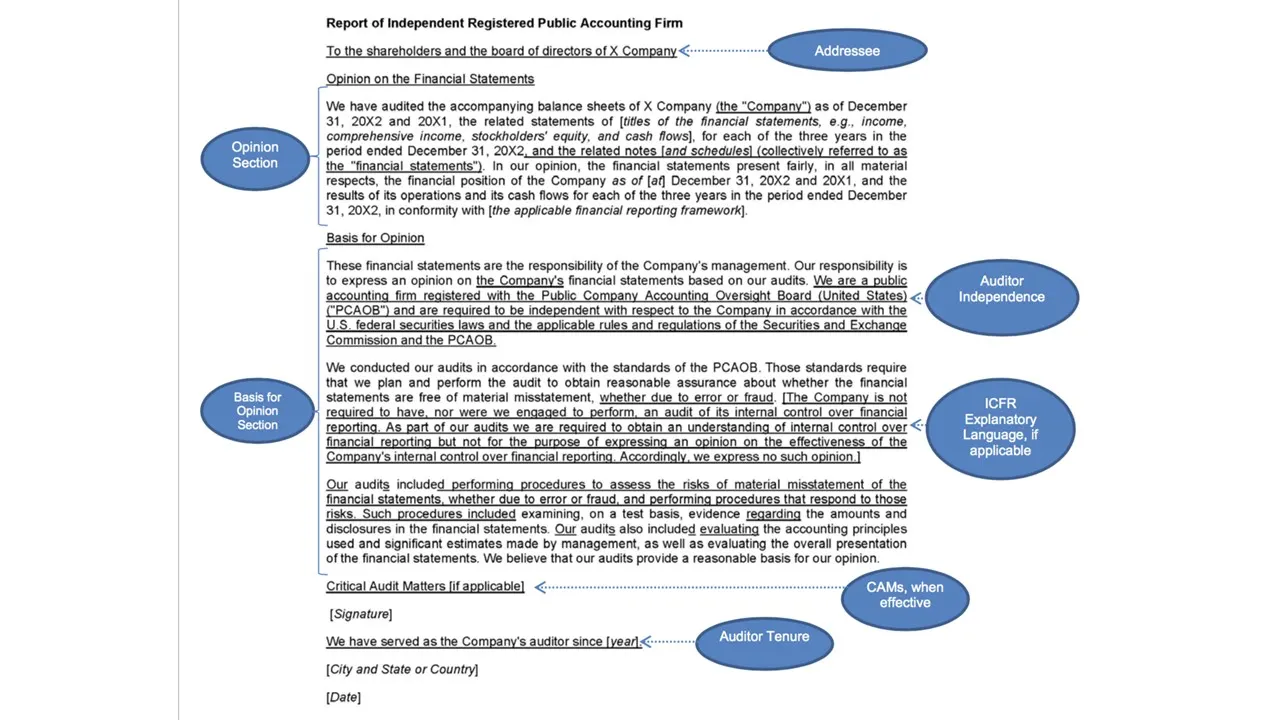
For the first time in 70 years, changes are being implemented to the existing report card from the auditor. The new standard, AS 3101, provides detailed guidance on “The Auditor’s Report on an Audit of Financial Statements When the Auditor Expresses an Unqualified Opinion.”


The standard is being implemented in two phases. In the first phase, changes are intended to provide information about auditor tenure and clarify the auditor’s responsibilities. In the second phase, the auditor is required to provide new information about the audit. The auditor’s report will continue to be a pass/fail model. Similar rules are already in effect in the U.K. and Europe.

New Standard

The new standard requires auditors to include a discussion of the critical audit matters (CAMs).

Critical Audit Matters

A critical audit matter (CAM) is defined as one that needs to be communicated to the audit committee related to accounts/disclosures that are material to the financial statements, or one that requires complex auditor judgment. The communication of each CAM in the auditor’s report includes:

  1. identification of the CAM;
  2. description of the principal considerations that led the auditor to determine that the matter was a CAM;
  3. description of how the CAM was addressed in the audit; and,
  4. reference to the relevant financial statement accounts or disclosures.

Additional Changes

The new standard also includes several other noteworthy changes:

  • Auditor tenure The auditor’s report will include a statement disclosing the year in which the auditor began serving consecutively as the company’s auditor;
  • Independence — The  auditor’s report also will include a statement that the auditor is required to be independent;
  • Enhancements to basic elements — Certain standardized language in the auditor’s report has been changed, including adding the phrase, “whether due to error or fraud,” when describing the auditor’s responsibility under PCAOB standards to obtain reasonable assurance about whether the financial statements are free of material misstatements;
  • Standardized form of the auditor’s report — The opinion will appear in the first section of the auditor’s report. Section titles have been added to guide the reader; and,
  • Addressees — The auditor’s report will be addressed to the company’s shareholders and board of directors or equivalents (additional addressees also are permitted).

Effective dates

New auditor’s report format, tenure, and other information: audits for fiscal years ending on or after December 15, 2017.

The effective dates for CAMs to be included in the auditor’s report are as follows:

  • For large accelerated filers: fiscal years ending on or after June 30, 2019;
  • For audits of all other companies: fiscal years ending on or after December 15, 2020

PCAOB published staff guidance on implementing the new changes.

March 25, 2018


 mailby feather

Accounting Firms Compete with Academic Institutions

Advanced learning and retooling via degree and non-degree programs has been the exclusive domain of academic institutions. The more reputable the academic institution, arguably, the higher is the quality of learning.

Things are about to change as one of the Big 4 accounting firms decides to enter the field of advanced learning. KPMG, a leading U.S. audit, tax, and advisory firm, broke ground for construction of its $450 million learning, development, and innovation facility in the Lake Nona community of Orlando.

KPMG

KPMG is one of the world’s leading professional services firms, providing innovative business solutions and audit, tax, and advisory services to many of the world’s largest and most prestigious organizations. KPMG is one of the Big 4 Accounting Firms (the other three being E&Y, PwC, and Deliotte).

KPMG LLP is the U.S. member firm of KPMG International Cooperative. KPMG International’s member firms have 189,000 professionals, including more than 9,000 partners, in 152 countries.

Stylized Facts

  • KPMG’s revenues for 2017 was $26.40 billion
  • Revenue growth for FY2017 was of 5%
  • KPMG invested more than US$1 billion this year in a multi-year program focused on new technology, innovation and developing new services and solutions
  • More than 37,000 new graduates and other entry-level professionals hired, with the total workforce growing to a record-high of 197,263 people.
  • KPMG network achieves gender parity for new hires, and an increase to 28% women in partner promotions across our 10 largest countries.

State-of the-Art Learning Facility

The firm announced on January 9, 2017 its commitment to create a 55-acre, state-of-the-art campus with 800,000 square feet of space for meeting, classroom, residential, and dining facilities. The campus will feature cutting-edge technology, including an innovation center that will support training and client engagement, and a heritage center to highlight the firm’s rich history and culture. KPMG expects to complete the project by year-end 2019.

The facility expected to accommodate 1,000 people at a time and has 800 single-occupancy rooms. It also has a four-star environment which includes multiple dining options, a coffee and wine bar, and a pub-like venue as well as “total wellness” amenities such as a sizable fitness facility and hiking and biking paths.

“This campus is our firm’s largest capital investment ever. More than that, it’s an investment in our people,” said Lynne Doughtie, Chairman and CEO, KPMG LLP. “Today marks a major milestone toward creating a world-class environment that inspires our professionals to achieve their fullest potential and helps enable our firm to attract and retain the best talent.”

Good or Bad?

Is this brand of executive education offered by US corporations good or bad for US academic institutions? The answer is unambiguously yes. Why?

  1. Any healthy competition between the for-profit and not-for-profit organizations can only improve the quality of education.
  2. The executives being trained will benefit as they get a broader perspective that is based on rigorous academic viewpoints and high quality practitioner experience.
  3. It increases the human capital of the attendees regardless of whether these forms of learning yield degrees or certificates in a specialized area.

As one of our Nobel Laureates said “For the times they are a-changing”

February 11, 2018

https://home.kpmg.com/us/en/home/media/press-releases/2017/05/kpmg-breaks-ground-on-400-million-learning-development-and-innovation-facility-in-lake-nona-announces-plans-to-hire-330-statewide.htmlmailby feather

Harvard’s Big Bath

We are all familiar with the notion of a bath in our communal lives, but the term “big bath” is equally common in the corporate world. Big Bath is an earnings management technique whereby a one-time charge is taken against income in order to reduce the value of an  assets.  This technique is often employed in a bad year, e.g., when sales are down, or when a company reports losses, to account for overvalued assets on the balance sheet.

Although the process is discouraged by auditors, it is frequently used by public companies. A notable feature surrounding big baths is that this accounting treatment tends to coincide with new management team because the new management team can then blame the one-time charges on the prior management team while simultaneously calibrating current reported income to unusually low levels thereby making it easier to meet or beat income in future periods.   

Big Bath in Non-profit Sector

Does Big Bath happen in the non-profit sector? Bien sûr!

 Harvard University has the largest endowment fund in the world with assets around $37 billion. The new chief of Harvard University’s endowment, Narv Narvekar, actively pushed to slash the value of some of its investments in natural resources portfolio of forests, farms and vineyards given his bearish outlook on some of the assets. Although Harvard University has the largest endowment, it was the only Ivy League endowment which generated less than 10% in the most recent year, which is why there was a “change of guards” at fund management level.

New endowment chiefs often have an incentive to write down investments they inherit because it is easier to blame the losses to the prior investment chief. It also helps remove potentially overvalued assets. Mr. Narvekar described Harvard Management Co. as having “deep structural problems” that would take five years to restructure. “An honest, reflective, and clear-sighted recognition of these problems is the first critical step towards generating solutions,” he wrote in his first annual letter in September, 2017.

Under Mr. Narvekar, Harvard reduced the value of its natural-resources investments by more than 25%, which is an unprecedented amount of a write-down (Harvard had valued the portfolio at roughly $4 billion at the end of the prior fiscal year).

Big Subjective Decisions

Many asset managers and appraisers say valuing assets that trade infrequently or aren’t generating cash—trees, for example, take years to grow before they can be sold for timber—is difficult. However, the new chief investment officer indicated that some natural-resources investments carried more risk than previously calculated. Therefore, he raise the discount rate (because the risk was high), which caused some investments to lose value.

Valuations for the endowment’s private assets were approved by the board, reviewed by Harvard and “the valuation process was independently verified by external auditors,” board Chairman said in a statement.

Big Pay Day

Harvard has guaranteed Mr. Narvekar at least $6 million a year for his first three years on the job. Additionally, the Chief is expected to earn additional performance-based compensation which is expected to be closely tied to the endowment’s performance in the long term.

When a non-profit sector mimics the pay of the for-profit sector in order to generate high future returns on the largest endowment fund!

https://www.wsj.com/articles/harvard-endowment-chief-pushed-for-steeper-devaluation-of-assets-1513252800

January 25, 2018mailby feather

A Pint of Guinness

A Porsche Cayenne achieved a new GUINNESS WORLD RECORDS™ title on the 21st of April, 2017, by towing an Airbus A380 over a distance of 42-meters. This feat by Porsche’s Cayenne beats the previous record for ‘heaviest aircraft to be towed by a production car’ by a margin of 115-tons.

Porsche is now a Guinness World Record holder. Cayenne is a Sports Utility Vehicle (SUV) manufactured by Porsche. The German SUV is credited with pulling the heaviest aircraft at Paris Charles de Gaulle Airport.

A Cayenne S Diesel, with a 4.1-liter V8 twin-turbo engine producing 380bhp, and more importantly, 850Nm of torque, was able to tug a colossal, 285 ton, 516 seat, 73 meters long Airbus A380 supplied by Air France over a distance of 42 meters. The achievement was then repeated by the Porsche Cayenne Turbo S, cementing Porsche firmly in the record books, whether the car be gasoline or diesel.

Air France devoted one of its fleet of ten A380 aircrafts to the project and the contrast between the two machines was striking. The Cayenne (measuring 4.8-meters in length) was connected to the most sophisticated and largest (73-meters) passenger aircraft in the world via a special towing attachment that sat on the Cayenne’s standard tow bar.

The previous Guinness World Record for heaviest aircraft pulled by a production car was set back in 2013 by a Nissan Patrol, which managed to tow an airplane weighing 170 tons. 

Pravin Patel, Adjudicator to the GUINNESS WORLD RECORDS attempt: “I’ve verified some amazing record attempts during my time as a GUINNESS WORLD RECORD adjudicator – watching a Porsche Cayenne tow one of the largest aircrafts in the world definitely ranks as among the most spectacular. My congratulations go out to all those involved in achieving this remarkable feat.”

Drive responsibly!

November 4, 2017

http://www.porschebrooklands.co.uk/about-us/2017/a-guinness-world-record-for-the-porsche-cayenne/a%20guinness%20world%20record%20for%20the%20porsche%20cayenne~~camtune~newsmodel~enmailby feather

(Un)Accountable Shell Games

A shell corporation often has no active business operations or hold any productive assets. Structured as an efficient financial vehicle, a shell corporation can serve as a convenient mechanism to raise funds, to complete a hostile acquisition or to take a company public. Nevertheless, these corporate structures can also be used for nefarious purposes some of which include disguising ownership from law enforcement or the public, or to evade taxes.

For instance, the “Panama Papers” leaks revealed that banks, political leaders and wealthy individuals had allegedly hidden billions of dollars in shell companies through a Panama law firm. The scheme allowed clients to evade taxes. Reportedly 214,000 shell companies were created to facilitate illegal activities.

Shell Games

Not all shell companies are creating to siphon off funds or to evade taxes. There can be merits to creating a shell company.

  • Fortunes
  1. A startup can use a shell corporation to safeguard its assets before officially launching its business.
  2. A company preparing for a merger or an acquisition can hold its assets in a shell company for legal reasons and keep those assets separately from the acquiring entity.
  3. Foreign companies can create shell companies in tax havens like Panama (Swiss private banking, Hong Kong, Belize are some of the other dubious and prominent tax havens) and lower their taxes at home. How so one may ask? Most tax haven countries do not mandate tax information for the funds being funneled into the tax haven countries via shell companies. Further, some tax havens do not report the existence of these shell companies to the government of the owners operating the shell companies thereby creating a “black hole.”
  • Misfortunes
  1. Shell companies are often set up to mask the identity of the individual owning assets in the company or to evade taxes.
  2. Occasionally, companies take advantage of the secretive nature of shell companies and engage illegal activities like money laundering.

Limited Games in the Land of the Free 

In the U.S., we are fortunate to have monitoring agents like the Securities and Exchange Commission, the Justice Department, and the Public Company Accounting Oversight Board (PCAOB) guarding the corridors of capital markets to ensure that public companies are not actively engaged in “shell games” to defraud minority shareholders.

In sharp contrast, and most inappropriately, in emerging markets and particularly in the BRICS countries, minority shareholders may not be as fortunate where the use of shell companies to hide business ownership or to evade taxes is rampant.

What is the auditors’ role in policing dubious shell companies which are actively created by publicly listed companies to siphon off funds and to dupe minority shareholders? 

Let the Games Begin in BRICS Countries

The Securities and Exchange Board of India (the counterpart of US SEC) is scrutinizing the functioning of auditors in various public companies in India, especially if the auditor has had a long-standing relationship with the client. Under the Companies Act of 2013, auditors, have greater responsibilities to ensure that financial statements of an Indian company are not materially misstated and that auditors red flag “dubious” transactions.

The Finance Ministry in collaboration with SEBI is taking actions against 331 listed suspected shell companies. More than 100,000 directors (holy cow!) may be disqualified for their association with shell companies. Investigations are in progress to identify professionals, chartered accountants, company secretaries and cost accountants associated with the defaulting companies.

The auditors are not exempt from these inspections. Authorities are looking at the possibility of having stricter scrutiny of global auditing firms (e.g., the Big 4 audit firms) and to make them more accountable when their auditors certify companies with a clean opinion even when clients are actively engaged in corporate misconduct.

Commentary on BRICS

Similar to the initiatives in India, China, where the problems of shell games are even more pervasive, under President Xi Jinping, has been actively confronting these problems. While these are modest steps, India and China can do more to bring the unaccountable or black money back into the mainstream economy for the betterment of their citizens.  

While India and China are at least attempting to tackle this social ailment, sadly not much can be said about the other 3 countries within the BRICS which include Brazil, Russia and South Africa where their top leaders appear to be the cause and not the solution to this social ailment.

http://timesofindia.indiatimes.com/business/india-business/auditors-come-under-lens-amid-crackdown-on-shell-companies/articleshow/60496210.cmsmailby feather

Enjoy A Perfect Dram of Acquavitae


Scotch whisky inspires a near cult-like devotion among circles with an affinity for malt beverages. Known for its pungent, peaty aroma with a long, lingering finish, Scotch whisky, the iconic malt beverage from Scotland, is designed to sip, and not shoot akin to its popular siblings like Vodka and Tequila.  

How to do you prefer sipping your favorite Scotch? This quintessential question can generate a diverse set of responses some of which include I take my Scotch neat, I prefer adding a splash or a few drops of water, I like my Scotch with a few ice cubes, or I like to blend my Scotch with soda and/or coca-cola.    

While there are no “correct” responses, because drinking alcoholic beverages is a matter of taste and preference, aficionados have long recommended taking your dram with a few drops of water. A Scotch enthusiast may ask why must I add water? The answers vary, but some of the more emblematic responses include:

  • Splash of water takes away the stinging or burning sensation when you “nose the whisky” thereby liberating the true spirit locked in the bottom of the glass to rise to the top
  • Splash of water dilutes the alcohol volume
  • Splash of water takes away the heady alcohol smell/taste away

Nose your Whiskey

To fully appreciate the spirit, which has been craftily aged in a barrel anywhere from 3 to 25 years, you must let the nose kiss the tip of your whisky glass and then proceed to inhale deeply (your chance to “inhale if you missed it when you were young and restless”). This ritual is very similar to how you get acquainted with, or nose, your red wine.  When nosing, we are paying careful attention to the following olfactory receptacles.

  • Smokiness: Flavor the peatiness as malted barley is often thrown over a peat fire to smoke it.
  • Saltiness: Smell the distinctly maritime smell mostly unique to Islay whiskies.
  • Fruitiness: Identify the fruits contained in the alcohol which may include dried currants, apricot, peach, or cherry.
  • Sweetness: Savor the discrete caramel, toffee, vanilla, honey tones or some other confections that you might decipher.
  • Woodiness: Oak is an integral companion of the whisky-aging process, which makes the smell of wood in Scotch omnipresent.

Swedish Connection

Bjorn Karlsson and Ran Friedman, a pair of Biochemists doing nose-breaking research at Linnaeus University in Kalmar, have finally provided a truly spiritual response to why splash of water is highly recommended for deriving the optimal olfactory pleasures from whisky consumption. Scottish whisky, especially the ones from the Island of Islay, contain a group of flavor-packed molecules known as “phenols” and “guaiacol.”

Laboratory simulations reveal that adding a splash of water or H2O makes guaiacol rise to “the air-liquid interface.” Because the drink is consumed at the interface first, adding water to whisky helps to enhance its taste. The concentrations of guaiacol are in much higher proportions in Scottish whiskies than in American or Irish ones, which is why the releasing of taste/flavors is much more pronounced in Scotch whisky than in its counterparts in the US or Ireland.

The fundamental conclusion from this original path-breaking scientific study is that it behooves us not to add a splash of water when we commiserate with our own spirits while leisurely sipping that perfect Scotch whisky.

Enjoy your Perfect Dram! High Noroc!

http://www.hindustantimes.com/more-lifestyle/for-the-love-of-scotch-new-study-cracks-why-whisky-tastes-better-with-water/story-r8GxpFBtTnmS8I0Oz82PQI.htmlmailby feather