Category: Auditing News

Bavarian Book-Keeping: Cash-in-out

Wirecard, a high flying publicly traded fintech company from Munich, Germany, has attracted major investors around the globe including SoftBank. In about a year, the stock price of the company rocketed from €41 in 2017 to €192 in 2018.

Recently, Wirecard has admitted to book-keeping or accounting fraud. The company declared that the $2.1 billion cash on its balance sheet is “missing” (a quarter of its Balance Sheet value). It is not that the company received cash (cash-in) and then the cash was stolen (cash-out). The company never acquired that cash! By recording fictitious revenues/profits, the company accumulated a mammoth “paper” cash balance of $2.1 billion. Welcome to Alchemy Accounting.

Regrettably, the investors are left with the hefty bill—the stock is trading today around one euro!  

WireCard Business

Wirecard specializes in digital payments. The company offers its customers electronic payment transaction services, risk management, and physical cards. Initially known for processing payments in controversial markets, the company evolved into a full-service global financial payments player from 2006 following the acquisition of a bank. The company became publicly traded from 2005 following a “reverse merger” with InfoGenie, a Berlin-based company.

Over the past decade Wirecard fueled its expansion through aggressive acquisition of smaller payment processing businesses including a major acquisition of 20,000 merchant clients of CitiBank in Asia-Pacific region.

What is Fintech

Fintech encompasses any kind of technology in financial services industry linking businesses with consumers through software or other technology/apps (from payment apps to cryptocurrency). Fintech has been used for many of the newest technological developments – from payment apps like PayPal, Venmo, and cryptocurrency.

Cooking the Books

As part of investigations of potential financial fraud, Financial Times (FT) concluded that there were reasons to suspect that Wirecard’s units in Singapore and other Asian countries may have engaged in accounting fraud. According to FT, one of Wirecard’s “third-party acquirer” (licensed by Visa and Mastercard to help retailers accept credit card transactions), a Dubai-based intermediary called Al Alam Solutions, contributed half of the German company’s worldwide profits in 2016. This third party acquirer had only six-seven staff members despite processing vast sums of transactions for 34 of Wirecard’s most important clients in the US, Europe, Middle East, Russia and Japan (around E350 million between 2016 and 2017). Neither Visa nor Mastercard have any record of a relationship with Al Alam.

Investigations raise doubts whether the sales and profits recorded by Al Alam were invented. For instance, Wirecard says the US payments processor CCBill was a multimillion-dollar-client of its partner company Al Alam Solutions but CCBill says it had no business with Al Alam. Similar cases of fraud may have been perpetrated by Wirecard Dublin office.

Wisecard and Big 4: E&Y is the external auditor

As the audit firm of Wisecard for nearly a decade, E&Y GmbH, the German affiliate of E&Y Global Limited (global umbrella organization for E&Y firms) issued unqualified opinions every year until 2018 despite increasing questions from journalists and short sellers over the company’s accounting practices. 

In 2019, Wirecard hired KPMG to investigate allegations raised by some in the media and sophisticated investors that a large share of Wirecard’s reported revenue-profits between 2016 and 2018 originated from a trio of third-party partners. In April, KPMG released a 74-page report saying it couldn’t verify the arrangements with the third parties because of lack of cooperation.

During its 2019 audit, E&Y concluded that it could not verify the cash balance of $2.1 billion held by trustee-controlled bank accounts in Philippines. Why would a German company hold cash in Asia that too in a trustee-controlled account? Wisecard’s explanation for such an unusual arrangement was that they were following risk management strategies and were reserving cash to process refunds and chargeback. Ironically, Germany’s central bank could not confirm that the money had entered its financial system.  

On Friday, a German shareholder association filed a criminal complaint to the prosecutors’ office in Munich accusing E&Y auditors of missing the alleged fraud.

Political Fallouts

In Germany, Financial Reporting Enforcement Panel (FREP), a quasi-private entity, supervises the financial statements of companies traded on the German stock exchange. Germany’s lead financial regulator BaFin often relies on the investigations initiated by FREP to supervise companies. Following the Wisecard accounting scandal, Justice and Finance Ministries decided to sever ties with FREP.

BaFin President Felix Hufeld is scheduled to testify behind closed doors to German parliament members.

Expect even more fallout!

https://www.ft.com/content/19c6be2a-ee67-11e9-bfa4-b25f11f42901
https://www.wsj.com/articles/wirecard-scandal-puts-spotlight-on-auditor-ernst-young-11593286933
mailby feather

Centurion Auditor: Good or Bad?

General Electric (GE) has been courting negative publicity because of its questionable accounting practices. The maker of jet engines, light bulbs and MRI machines is being bombarded with lingering questions about its reporting practices.

In 2009, the SEC charged GE with accounting fraud and overly aggressive accounting practices, which lead to false and misleading statements to investors. GE paid $50 million to settle those charges without admitting to or denying wrongdoing.

Last year, the SEC started an investigation into the company’s accounting practices related to revenue recognition. The SEC investigation was expanded in scope following the reporting of $6.2 billion loss on its portfolio of long-term care insurance policies.

Who GE’s Auditor?

A centurion, KPMG is the external auditor of GE and they have been so for the past 109 years.

Regulators and media often hold the viewpoint that long-tenured auditors can become too close to a client, which erodes audit quality, while a new auditor can be more efficient in uncovering problems previously unidentified, which leads to enhanced audit quality. Many commentators and analysts believe that, in the case of GE, the auditor’s extensive tenure has jeopardized KPMG’s independence which ultimately questions the audit quality rendered by the firm. 

KPMG is part of an exclusive audit club, also known as the “Big 4” (others are E&Y, Deloitte, and PWC) revered for their professional expertise and commitment to independence. Yet, that pristine reputation has been lacking lately for KPMG—the firm has been chasing its own demons.

  • In the USA, six accountants, including former employees of PCAOB, were charged with leaking confidential data to KPMG. The SEC said the sensitive information helped KPMG clear regulatory inspections at a time when the firm was under pressure to clean up its audit record (akin to dishonesty in an exam).
  • In South Africa, KPMG’s South Africa division found the accounting firm had missed red flags in its auditing of companies owned by the Gupta family in that country. South Africa is arguably KPMG’s most important market in Africa, as it boasts the continent’s most industrialised economy, its biggest companies and its largest stock market (lacking independence).
  • In Canada, KPMG’S Canadian division is the subject of two complaints from one of the country’s largest financial worker’s unions. KPMG is charged with setting up offshore tax structures in the Isle of Man to help wealthy Canadians avoid paying taxes, which is against the profession’s code of conduct” (violation of professional code of ethics).

Shareholder Watchdogs

Shareholder watchdog groups worry that GE and KPMG may have become “too cozy” during their 109-year-old relationship. Both Glass-Lewis and Institutional Shareholder Services are urging shareholders not to ratify KPMG as GE’s auditor at the company’s annual shareholder meeting on Wednesday.

Ultimate Outcome

KPMG is most likely to continue to serve as the external auditor of GE despite widespread shareholder dissatisfaction with KPMG. The negative proxy votes not to ratify KPMG as the auditor satisfaction in annual shareholder meetings are unlikely to topple the audit firm. Why?

Under the current US regulations, only GE’s Audit Committee (a subcommittee of GE’s board consisting of independent members) has the ultimate authority to retain or dismiss auditors. The audit committee is also free to ignore how shareholders may feel about the auditor.

This is what we call “hullaballoo!”

May 8, 2018mailby feather

A Refined Report From The Auditor

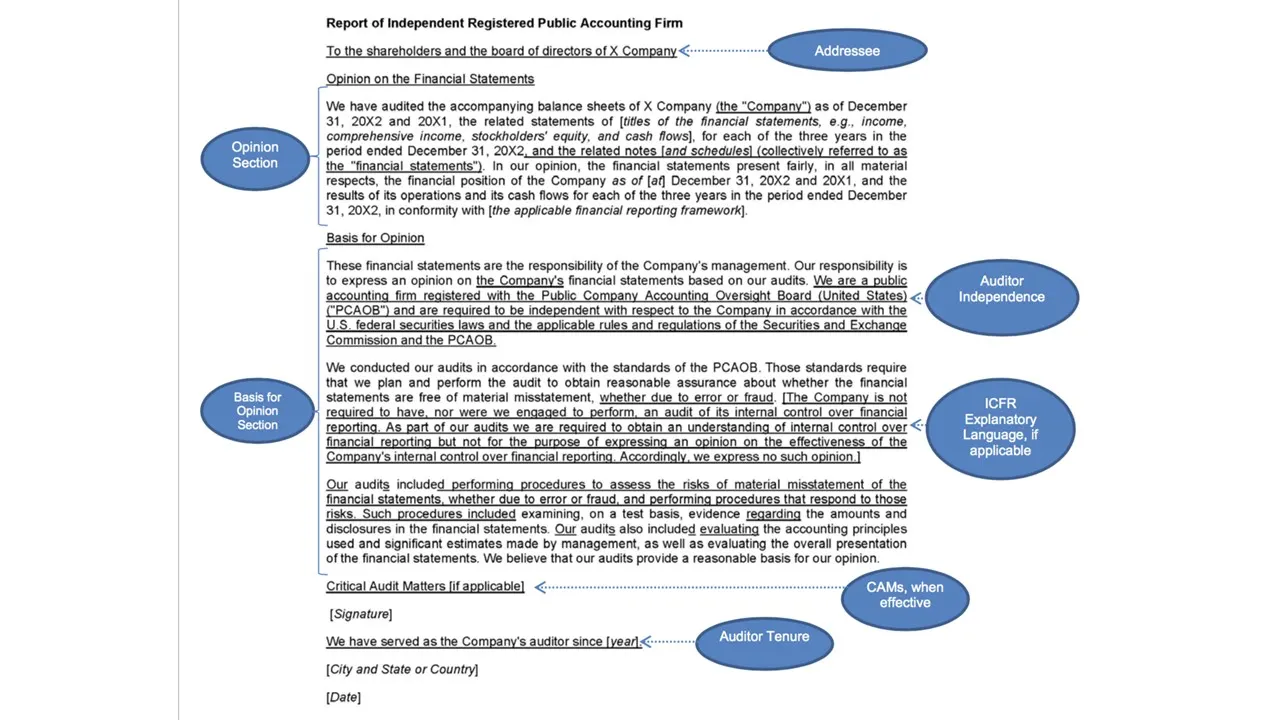
For the first time in 70 years, changes are being implemented to the existing report card from the auditor. The new standard, AS 3101, provides detailed guidance on “The Auditor’s Report on an Audit of Financial Statements When the Auditor Expresses an Unqualified Opinion.”


The standard is being implemented in two phases. In the first phase, changes are intended to provide information about auditor tenure and clarify the auditor’s responsibilities. In the second phase, the auditor is required to provide new information about the audit. The auditor’s report will continue to be a pass/fail model. Similar rules are already in effect in the U.K. and Europe.

New Standard

The new standard requires auditors to include a discussion of the critical audit matters (CAMs).

Critical Audit Matters

A critical audit matter (CAM) is defined as one that needs to be communicated to the audit committee related to accounts/disclosures that are material to the financial statements, or one that requires complex auditor judgment. The communication of each CAM in the auditor’s report includes:

  1. identification of the CAM;
  2. description of the principal considerations that led the auditor to determine that the matter was a CAM;
  3. description of how the CAM was addressed in the audit; and,
  4. reference to the relevant financial statement accounts or disclosures.

Additional Changes

The new standard also includes several other noteworthy changes:

  • Auditor tenure The auditor’s report will include a statement disclosing the year in which the auditor began serving consecutively as the company’s auditor;
  • Independence — The  auditor’s report also will include a statement that the auditor is required to be independent;
  • Enhancements to basic elements — Certain standardized language in the auditor’s report has been changed, including adding the phrase, “whether due to error or fraud,” when describing the auditor’s responsibility under PCAOB standards to obtain reasonable assurance about whether the financial statements are free of material misstatements;
  • Standardized form of the auditor’s report — The opinion will appear in the first section of the auditor’s report. Section titles have been added to guide the reader; and,
  • Addressees — The auditor’s report will be addressed to the company’s shareholders and board of directors or equivalents (additional addressees also are permitted).

Effective dates

New auditor’s report format, tenure, and other information: audits for fiscal years ending on or after December 15, 2017.

The effective dates for CAMs to be included in the auditor’s report are as follows:

  • For large accelerated filers: fiscal years ending on or after June 30, 2019;
  • For audits of all other companies: fiscal years ending on or after December 15, 2020

PCAOB published staff guidance on implementing the new changes.

March 25, 2018


 mailby feather

Accounting Firms Compete with Academic Institutions

Advanced learning and retooling via degree and non-degree programs has been the exclusive domain of academic institutions. The more reputable the academic institution, arguably, the higher is the quality of learning.

Things are about to change as one of the Big 4 accounting firms decides to enter the field of advanced learning. KPMG, a leading U.S. audit, tax, and advisory firm, broke ground for construction of its $450 million learning, development, and innovation facility in the Lake Nona community of Orlando.

KPMG

KPMG is one of the world’s leading professional services firms, providing innovative business solutions and audit, tax, and advisory services to many of the world’s largest and most prestigious organizations. KPMG is one of the Big 4 Accounting Firms (the other three being E&Y, PwC, and Deliotte).

KPMG LLP is the U.S. member firm of KPMG International Cooperative. KPMG International’s member firms have 189,000 professionals, including more than 9,000 partners, in 152 countries.

Stylized Facts

  • KPMG’s revenues for 2017 was $26.40 billion
  • Revenue growth for FY2017 was of 5%
  • KPMG invested more than US$1 billion this year in a multi-year program focused on new technology, innovation and developing new services and solutions
  • More than 37,000 new graduates and other entry-level professionals hired, with the total workforce growing to a record-high of 197,263 people.
  • KPMG network achieves gender parity for new hires, and an increase to 28% women in partner promotions across our 10 largest countries.

State-of the-Art Learning Facility

The firm announced on January 9, 2017 its commitment to create a 55-acre, state-of-the-art campus with 800,000 square feet of space for meeting, classroom, residential, and dining facilities. The campus will feature cutting-edge technology, including an innovation center that will support training and client engagement, and a heritage center to highlight the firm’s rich history and culture. KPMG expects to complete the project by year-end 2019.

The facility expected to accommodate 1,000 people at a time and has 800 single-occupancy rooms. It also has a four-star environment which includes multiple dining options, a coffee and wine bar, and a pub-like venue as well as “total wellness” amenities such as a sizable fitness facility and hiking and biking paths.

“This campus is our firm’s largest capital investment ever. More than that, it’s an investment in our people,” said Lynne Doughtie, Chairman and CEO, KPMG LLP. “Today marks a major milestone toward creating a world-class environment that inspires our professionals to achieve their fullest potential and helps enable our firm to attract and retain the best talent.”

Good or Bad?

Is this brand of executive education offered by US corporations good or bad for US academic institutions? The answer is unambiguously yes. Why?

  1. Any healthy competition between the for-profit and not-for-profit organizations can only improve the quality of education.
  2. The executives being trained will benefit as they get a broader perspective that is based on rigorous academic viewpoints and high quality practitioner experience.
  3. It increases the human capital of the attendees regardless of whether these forms of learning yield degrees or certificates in a specialized area.

As one of our Nobel Laureates said “For the times they are a-changing”

February 11, 2018

https://home.kpmg.com/us/en/home/media/press-releases/2017/05/kpmg-breaks-ground-on-400-million-learning-development-and-innovation-facility-in-lake-nona-announces-plans-to-hire-330-statewide.htmlmailby feather

Harvard’s Big Bath

We are all familiar with the notion of a bath in our communal lives, but the term “big bath” is equally common in the corporate world. Big Bath is an earnings management technique whereby a one-time charge is taken against income in order to reduce the value of an  assets.  This technique is often employed in a bad year, e.g., when sales are down, or when a company reports losses, to account for overvalued assets on the balance sheet.

Although the process is discouraged by auditors, it is frequently used by public companies. A notable feature surrounding big baths is that this accounting treatment tends to coincide with new management team because the new management team can then blame the one-time charges on the prior management team while simultaneously calibrating current reported income to unusually low levels thereby making it easier to meet or beat income in future periods.   

Big Bath in Non-profit Sector

Does Big Bath happen in the non-profit sector? Bien sûr!

 Harvard University has the largest endowment fund in the world with assets around $37 billion. The new chief of Harvard University’s endowment, Narv Narvekar, actively pushed to slash the value of some of its investments in natural resources portfolio of forests, farms and vineyards given his bearish outlook on some of the assets. Although Harvard University has the largest endowment, it was the only Ivy League endowment which generated less than 10% in the most recent year, which is why there was a “change of guards” at fund management level.

New endowment chiefs often have an incentive to write down investments they inherit because it is easier to blame the losses to the prior investment chief. It also helps remove potentially overvalued assets. Mr. Narvekar described Harvard Management Co. as having “deep structural problems” that would take five years to restructure. “An honest, reflective, and clear-sighted recognition of these problems is the first critical step towards generating solutions,” he wrote in his first annual letter in September, 2017.

Under Mr. Narvekar, Harvard reduced the value of its natural-resources investments by more than 25%, which is an unprecedented amount of a write-down (Harvard had valued the portfolio at roughly $4 billion at the end of the prior fiscal year).

Big Subjective Decisions

Many asset managers and appraisers say valuing assets that trade infrequently or aren’t generating cash—trees, for example, take years to grow before they can be sold for timber—is difficult. However, the new chief investment officer indicated that some natural-resources investments carried more risk than previously calculated. Therefore, he raise the discount rate (because the risk was high), which caused some investments to lose value.

Valuations for the endowment’s private assets were approved by the board, reviewed by Harvard and “the valuation process was independently verified by external auditors,” board Chairman said in a statement.

Big Pay Day

Harvard has guaranteed Mr. Narvekar at least $6 million a year for his first three years on the job. Additionally, the Chief is expected to earn additional performance-based compensation which is expected to be closely tied to the endowment’s performance in the long term.

When a non-profit sector mimics the pay of the for-profit sector in order to generate high future returns on the largest endowment fund!

https://www.wsj.com/articles/harvard-endowment-chief-pushed-for-steeper-devaluation-of-assets-1513252800

January 25, 2018mailby feather

Taxing on the Brain

Some U.S. multinational companies are avoiding paying high U.S. taxes through relatively simple tax strategies. If a U.S. multination company generates part of its income in a foreign jurisdiction, the foreign income is not subject to U.S. taxes until it gets repatriated back to the US. Contrary to personal income tax, which is levied on all sources of income regardless of where the income is earned, only U.S-based income is subject to taxes for U.S. corporations. The foreign income earned is subject to US taxes once the money is transferred back to the U.S. for redistribution or reinvestment.

Therefore, U.S. citizens cannot shelter foreign income from U.S. taxes, but U.S. companies are able to do so.

Another tax strategy to shelter income from U.S. taxes is more dubious in nature where the objective is to attribute a higher percentage of the income to a foreign jurisdiction with low tax rate even when the income is not economically earned in the foreign jurisdiction.

The Pillar in the Cat-and-Mouse Strategy

Caterpillar is under intense scrutiny for shifting much of the profit from its lucrative replacement-parts business to a Swiss subsidiary where the tax rates are low. The strategy, which dates back to the late 1990s, has generated an employee lawsuit, a U.S. Senate investigation, and a federal criminal investigation that led raids on Caterpillar’s headquarters and two facilities in Illinois.

How large is the tax avoidance? According to a U.S. Senator (see the April request from Sen. Carl Levin, D., Mich., for the PCAOB to look into the tax avoidance matter), Caterpillar has deferred $2.4 billion in taxes under strategies devised by PricewaterhouseCoopers LLP.

CtW, an investment group, wants to shake up the company’s audit committee following the terminator’s (machinery giant) offshore tax strategy. The investment group, has issued a public letter asking shareholders to vote against Caterpillar’s three board members because of inadequate oversight of tax strategy and dysfunctional monitoring of the external auditor. In the case of Caterpillar, PricewaterhouseCoopers LLP happens to be both the external auditor and the  tax consultant!

The audit committee members of Caterpillar include

  • Daniel Dickinson, a private-equity executive
  • Dennis Muilenburg, Chairman and CEO of Boeing Co.
  • William Osborn, former Chairman and CEO of Northern Trust Corp.

Conflict or Efficiency

By serving as the tax consulting and external auditor, does PricewaterhouseCoopers LLP generate efficiencies for the company or is there a conflict of interest whereby the audit quality suffers because the external auditor is no longer an independent monitor of the company’s financial statements.   

Independent or Dependent

PricewaterhouseCoopers has been Caterpillar’s independent auditor since 1925, according to the 2017 proxy statements filed by Caterpillar, which means the big accounting firm has been with this client for almost a century! Can an auditor with a century long relationship with a client provide high quality audit assurance?

How much has the accounting firm earned from this company?

Audit services              Tax consulting             Total Fees

2016                                        $33 million                  $0.1 million                 $35 million

2015                                        $32 million                  $20 million                  $54 million

Why did tax consulting fees drop suddenly in 2016? Too much political heat?

If you use 2016 fees as a proxy for annual fees earned by the auditor for the prior years, which is an exaggerated assumption, PricewaterhouseCoopers has earned around $3 billion from the Terminator since 1925.

I wish we could buy shares of PricewaterhouseCoopers!

Is PricewaterhouseCoopers a tax consultant or an “external” auditor for Caterpillar? Does PricewaterhouseCoopers have the conviction to question accounting practices adopted by Caterpillar and confront questionable accounting practices in light of this money train?

Your guess is as good as mine…..

May 29, 2017mailby feather

Italian Job

BT shares, which trade in the US as ADRs (BT Group plc), have declined by more than 45% in less than a year. Around half of that descent was confined to a single day last month (Jan 23) when the company announced accounting improprieties associated with its Italy-based operations. The company also noted that some senior management personnel may have embezzled funds. UK’s parent BT shares have shed more than 8 billion pounds because of this accounting scandal.

Italian prosecutors have initiated their own investigation into BT Italia’s accounting fraud. BT Group Plc has been hit by at least two shareholder lawsuits in the U.S. A number of other US law firms specializing in shareholder class action suits are considering filing lawsuits against the company and senior management.

British Telecommunications (BT)

BT Group plc is a holding company which owns British Telecommunications plc, a British multinational telecommunications services company with head offices in London. The company has operations in around 180 countries. The company’s shares are among the most widely owned stocks in the UK. The ownership of BT shares is widely dispersed ̶ about 700,000 of its 827,000 shareholders own 1,600 or fewer shares of the company.

BT ADRs

American depositary receipts (ADRs) were introduced in 1927 as an easier way for U.S. investors to purchase stock in foreign companies. Non-U.S. companies also benefit from ADRs as it makes it easier to attract American investors. ADRs are negotiable certificates issued by a U.S. bank representing a specified number of shares (or one share) in a foreign stock traded on a U.S. exchange.

ADRs are denominated in U.S. dollars, with the underlying security held by a U.S. financial institution overseas, and holders of ADRs realize any dividends and capital gains in U.S. dollars, but dividend payments in euros are converted to U.S. dollars, net of conversion expenses and foreign taxes. ADRs are listed on either the NYSE, AMEX or Nasdaq but they are also sold OTC.

Italian Job

The fraudulent transactions related to BT-Italy emerged sometime during the summer of 2016 following an internal probe into its Italian business after a “whistleblower” flagged concerns. A whistleblower is an employee who discloses information about illegal acts, mismanagement, abuse of power, or general wrongdoing occurring in the company. If the company is publicly traded and subject to the filing requirements of the Securities and Exchange Commission, whistleblowers are protected by law from retaliation in the US. Some of the major US companies perpetrating accounting fraud were caught and brought to justice by their own employees (e.g., Enron, Freddie Mac, Madoff).

Upon investigation, BT discovered “inappropriate management behavior” within the Italian division. The expected cost of the rent extraction initiated by the Italian subsidiary was estimated to be around £145 million. Sometime in January this year, just days prior to the announcement of the third-quarter results, the company released a statement declaring that, according to an independent investigation by the Big 4 accounting firm KPMG, the losses to BT from the accounting irregularities related to Italian operations were being reassessed at £530m, which is almost 4 times larger than the previously estimated number.

The company suspended several BT Italy’s senior management team. BT has also appointed a new chief executive of BT Italy who took charge of Italy’s operations from Feb. 1.

Telecom Blues

What remains troubling is why wasn’t the accounting irregularity detected by UK’s parent company much earlier. Nick Rose, the chairman of the BT’s audit committee, flagged internal-control issues in Italy in every annual report since May 2013. Yet, the persistent accounting fraud was not detected until 3 years later. By blaming BT-Italy for all the current problems, the CEO of BT may be attempting to distance the parent company, and himself, from the Italian operations by censuring a few perpetrators.

What is even more worrisome is why didn’t the auditors detect this size of an accounting fraud earlier? Independent auditors are expected to provide an assurance that the financial statement are free of material misstatements. One would agree a misstatement exceeding $600 million is material.

Who was BT’s independent auditor? The answer is PwC, which a Big 4 global accounting giant. PwC has been BT’s auditor for the last 30-year since 1984. It is unclear whether BT intends to end its business relationship with PwC. The big accounting firms are renowned for rendering high audit quality so this type of an accounting fraud is likely to a huge set-back for PwC.

Moody’s has warned it may cut BT’s credit ratings. Analysts are skeptical whether the company can afford to maintain a 10 percent growth in its dividend.

Randoph, February 2, 2017


 mailby feather

Accounting’s Got Talent

accountingtoday-top-100Financial economics, as the title of the discipline suggests, is an embedded field within mainstream economic sciences. Therefore, it should not come as a surprise that quite a few Nobel Laureates in economics are finance professors who have done pioneering work in financial economics.

Closely linked with economics and finance, mainstream accounting research is derived from economics and financial economics. While there are a few strong delineators between finance, economics and accounting, the three fields intermingle and influence one another which is why it is difficult to have a strong grasp of one without at least a basic understanding of the other two.

Yet, accounting has never been considered part of mainstream economic sciences which is why no accounting researcher has won the Nobel Prize. Not to be outdone, the accounting profession has created a list of 100 most influential individuals, thought leaders, and visionaries who are responsible for shaping the accounting profession.

Requirements For Top 100

Gaining entry into the coveted top 100 Most Influential Person in Accounting is a daunting task. The Accounting Today complied the Top 100 list using the following criteria.

  • Innovator and creator. The individual must have created new ways to market the accounting/auditing professional services.
  • Educator. The individual must have taught the profession something the profession didn’t know already.
  • Regulator. The individual must have been involved in enforcing rules which had a game changing influence on the profession.
  • Elevator. Individuals who help achieve the ideals of the profession, or and those who are actively planning the future of the profession, are deemed the most influential of all.

What is the gender composition? Among the top 100 most influential accounting professionals, 70% are males and the remaining 30% are females.

Top 5

The top 100 most influential accounting professionals then voted to pick the Top 5 thinkers within the profession. The Superstars in Accounting are:

  1. Barry Melancon: President and CEO of AICPA
  2. Tom Hood: CEO and Executive Director of MACPA
  3. Mary Jo White: Chair, SEC
  4. Russell Golden: Chairman of FASB
  5. Ron Baker: Founder of VeraSage Institute

MIA

Surprisingly, no academic made it to the Top 100 list. Although academics meet the threshold requirement as an educator, presumably, Accounting Today does not consider academics to be influential enough to teach something to the profession that the profession didn’t know already. Academics are merely disseminating accounting/auditing knowledge that is already codified by the profession so academics are not deemed as innovators in the field.

We salute the Top 100 Most Influential Accounting Professionals!

Chatham; September 10, 2016

http://pages.marketing.accountingtoday.com/act_unsponsored_75635_sr_lp.html

 mailby feather

GE, The Illuminati

Illuminati-Logo---BlackGeneral Electric, the giant American industrial conglomerate, filed its 2015 annual report (10-K) with the Securities and Exchange Commission (SEC) on February 16, 2016. The annual report document contains 276 pages of text, numbers, tabular presentations and pictures. Large accelerated filers, or large public companies, are required to file their annual financial reports, also termed as Form 10-K, within 60 days of their fiscal year-end unless they are smaller public firms in which case they have either 75 days (accelerated filers) or 90 days (non-accelerated filers) to file depending on their market capitalization.

In an effort to make annual reports more understandable to investors, in a game-changing disclosure strategy, the company released its first ever “Integrated Summary Report.” The key objective is to provide a comprehensive yet concise view of the company using the lens of the Board and management. The compact report contains only 66 pages with pertinent information from several mandated documents including 10-K, proxy statements, and sustainability report. The document establishes links between strategy, performance, board oversight, compensation and sustainability but it remains outside the realms of the heavily regulated financial reporting.

The Illuminati

Navigating through any 276-page document can be challenging for an individual, let alone one that is derived from a complex set of accounting rules and regulation. The Chairman and CEO of General Electric, Jeff Immelt, said “our priority is to provide meaningful information that all investors can readily access. For investors to make investment and voting decisions, we don’t believe that more information is necessarily better. Instead, we’ve challenged ourselves to provide better information. Over the past several years, we have already been enhancing our reporting in response to feedback from investors, and they have told us how much they like it. This year, we are taking it even further.”

According to a GE spokesman, investors downloaded the integrated and summary report 2,300 times in the first 24 hours after it was published. In contrast, GE’s combined downloads of its 10-K and proxy reports 24 hours after they were filed last year were only 638.

Contents

The integrated summary report includes a discussion on the following subjects:

  • Chairman’s Letter
  • Strategy and results
  • GE’s Businesses, Portfolio & Capital Allocation
  • Margins and Financials
  • Risk, Governance and Compensation
  • Audit
  • Shareowner Proposals
  • Sustainability
  • Annual Meeting
  • Forward-Looking Statements

 Simplification

It remains uncertain whether other large companies will follow GE’s pathway and start disclosing similar condensed annual reports. The SEC has been deliberating ways to simplify financial reporting so GE might become the vanguard of simplified annual reporting.

New York, April 7, 2016; 2.40P

http://www.ge.com/ar2015/integrated-report.mailby feather

2016 UTS Summer Accounting Conference

UTSThe UTS Summer Accounting Conference attracts leading accounting and auditing scholars from around the world. The Accounting Discipline Group at UTS is committed to ensuring that the Australian Summer Accounting Conference continues as the premier event of its type in the Australasian region.

Registrations are now open to attend the 19th annual Australian Summer Accounting Conference.  The 2016 conference will comprise a key-note address by Professor Katherine Schipper, Faqua Business School, Duke University, and 11 paper presentations, each of which will be followed by an invited discussant. 

There is no charge for attending the conference; however attendees are responsible for their own travel and accommodation costs, late cancelations and or no shows to the conference/dinner will incur an administrative fee of $50.00.  Morning tea, lunch and afternoon tea will be provided, on each of the two days.  Additionally, conference attendees are invited to a dinner held on the evening of Thursday, 4th of February at the Park Royal Hotel.  The conference will conclude on Friday, 5th of February with drinks and canapés.  Places are strictly limited and anyone wishing to attend should register as soon as possible.

Presenters Title
Aloke Ghosh City University of New York


Chandra Kanodia University of Minnesota

The Quality of Audit Stress Tests of Goodwill for impairments


What are the Economic Consequences of Fair Value Accounting?

Yu Flora Kuang University of Melbourne The Influence of CEO Social Capital on Firm Value: Evidence from CEO Succession
Xi Li Temple University Mandatory Disclosure Reform, Monitoring, and Executive Compensation
Elisabeth Dedman Nottingham University The Information Content of Accounting Accruals when Accompanied by Cash or Stock Dividends
Thomas Bourveau Hong Kong University of Science and Technology Shareholder Activism and Voluntary Disclosure
Emmanuel De George London Business School Starving for information: Does reporting frequency affect how earnings news travels around the world?
Scott Liao  University of Toronto Does Loan Loss Provision Timeliness Affect the Accuracy, Informativeness, and Predictability of Analyst Provision Forecasts?
Christo Karuna University of Southern California Competition and Earnings Management
Gopal Krishnan American University Do Auditors with a Deep Pocket Provide a High Quality Audit?
Sterling Huang  Singapore Management University Corporate Hedging and the Design of Incentive-Compensation Contracts

 When

4 – 5 February 2016 9:00 am – 4:00 pm

Where

City – Haymarket›CB08 Dr Chau Chak Wing Building, Building 8

Places to the conference are strictly limited.  Please treat your registration as a firm commitment as subsequent cancellations are costly and create administrative difficulties with waitlists. Late cancelations and or no shows to the conference/dinner will incur an administrative fee of $50.00.

14-

Cost

Complimentary – Please refer to the conditions noted above

RSVP

General enquiries about the conference (including paper submissions or requests for invitations) should be directed to:

Katt Robertson – Accounting Discipline Group UTS Business School Email: [email protected] Ph. 61 2 9514 3560  

http://www.uts.edu.au/about/uts-business-school/accounting/what-we-do/research/events/2016-uts-australian-summermailby feather