
CategoryFinancial Statement Analysis

How Mobil(e) is ExxonMobil?

Losing Triple A Credit Rating

Losing Triple A Credit Rating

ExxonMobil Corp. had the honor and distinction of having a gold-plated AAA credit rating since the post WWII period. However, fortunes can change abruptly when one is trading products of mother nature. Last week, Standard & Poor’s (S&P) downgraded Exxon Mobil’s credit rating for the first time in almost 70 years from the coveted “AAA” rating to a “AA+” rating citing expectations of continuing low oil prices. ExxonMobil joins two other US companies with S&P AA+ credit ratings; General Electric Co. and Apple Inc. The two remaining US companies with the highest possible corporate AAA debt ratings are Johnson & Johnson and Microsoft Corp.

Exxon Mobil History

ExxonMobil is an American multinational oil and gas company based in Texas. It is the largest direct descendant of John D. Rockefeller’s Standard Oil Company. Exxon Mobil was formed in 1999 by the merger of Exxon (formerly Standard Oil Company of New Jersey) and Mobil (formerly the Standard Oil Company of New York). ExxonMobil is also the Fifth largest publicly traded company by market capitalization. ExxonMobil was the second most profitable company in 2014.

Downgrade Reasons

S&P stated that the “company’s debt level has more than doubled in the recent years, reflecting high capital spending on major projects in a high commodity price environment and dividends and share repurchases that substantially exceeded internally generated cash flow.”

S&P also said that while Exxon made efforts to reduce capital spending, the maintenance of production and replacing reserves will ultimately require the company to spend more. Because the company is returning cash to shareholders, instead of building cash or reducing its debt, the company faces limits on credit improvements even when oil prices recover.

S&P cautioned that it could further lower its rating on Exxon if the company is unable to sufficiently adapt to a prolonged period of low commodity prices. The downgrade is not a complete surprise. In February, S&P downgraded rival Chevron Corp and warned that such a move was also possible for Exxon.

Shareholder Payments

ExxonMobil paid out $325 billion as dividend and share repurchases over the last 11 years which exceeded its outlays for new property, plant and equipment of $272 billion over the same period. During the fourth quarter of 2015, the company paid out $3.6 billion in dividends and share repurchases, which is more than it earned in that quarter.

In February, Exxon Mobil changed its strategy and declared that it would only repurchase shares to offset dilution, and not pay back cash as dividend.  

Why Repurchase Over Dividend

Many companies prefer stock repurchase over dividends. One explanation is accounting based therefore cosmetic and the second explanation is more economic.

Investors tend to focus on accounting earnings, mostly earnings per share (EPS), which is computed as net income divided by number of shares outstanding. When a company buys back (repurchases) its own stock, it reduces the shares outstanding and thereby increases its EPS. This type of an increase in reported EPS is cosmetic (nip and tuck). Shareholders care about the pie (earnings) and not how the pie is being shared (EPS). So stock buyback initiated to increase EPS is a akin to a magician’s show intended to circumvent reality.

The advantage of stock buyback is that it is a one-time cash payout unless the company elects to announce future buybacks. Dividends, on the other hand, are more permanent in nature and investors expect continuation of dividend payments when one is announced. Therefore, companies wanting to preserve future cash prefer stock buyback over dividend.

ExxonMobil wants to buyback stock to offset the stock price decline from declining oil prices. Given the low oil prices, it has cut back on its planned investments or production capacity. However, when oil prices bound back, it wants to preserve cash to fund its future growth which is why it prefers stock buyback over dividend.

Stock Price

ExxonMobil’s stock price went down from a high of around $103 in 2014 to a low of $72 in 2015. The stock is back at around $90. With oil prices trending up, we can only expect ExxonMobil’s stock price to continue its upward trajectory.

Chatham; June 11, 2.11P

http://www.reuters.com/article/us-exxon-mobil-ratings-s-p-idUSKCN0XN26L?feedType=RSS&feedName=businessNews&utm_source=feedburner&utm_medium=feed&utm_campaign=Feed%3A+reuters%2FbusinessNews+%28Business+News%29

mailby feather

The Mexican Wall (Mart) Spectacle

walmartWal-Mart Stores, the leading private employer in the world, operates in 25 countries with a strong presence in Mexico. Roughly about 20% of Wal-Mart’s 11,500 locations are based in Mexico. Over the last three years, the Justice Department has been investigating allegations that Wal-Mart paid bribes in Mexico to obtain permits. 

A group of beneficial Wal-Mart owners filed a complaint with the Securities and Exchange Commission (SEC) and the Public Company Accounting Oversight Board (PCAOB) that Wal-Mart’s auditor, Ernst & Young (E&Y) was aware of the bribery long before the company disclosed this irregularity to U.S. authorities in 2011. According to the complaint letter, E&Y as the independent auditor should have reported the suspected bribery to the SEC as soon as it became aware of such improprieties in 2006.

Bribery Act

The Foreign Corrupt Practices Act of 1977 (FCPA) makes it unlawful for persons and entities to make payments to foreign government officials to assist in obtaining or retaining business. The Act was amended in 1998. The anti-bribery provisions of the FCPA now applies to foreign firms and makes it illegal for foreign companies to pay bribes in the U.S.

The Act levies criminal and civil liability for paying bribes to foreign government officials. The Justice Department has jurisdiction over the FCPA.

Investigations

The Justice Department launched an investigation following a 2012 New York Times article about the alleged Mexican bribes. According to the article, Wal-Mart Mexico unit paid middlemen to obtain permits and that Wal-Mart executives chose not to pursue an internal inquiry into the suspicious payments.

Although the three-year investigation remains incomplete, according to Wall Street Journal, the case could be resolved with a fine and no criminal charges against Wal-Mart executives because the charges may not be as severe as previously anticipated.

Auditor’s Obligations

According to the auditing standards (AU section 317), auditors have a responsibility to design procedures that provide reasonable assurance of detecting illegal acts. In cases of bribery, the auditor is also implicated because bribing a foreign government official is illegal in the US and also because any bribery is likely to have a material effect on a company’s financial statements.

Companies that pay bribes generally record the underlying transactions in their accounting books as legitimate operating expenses to avoid detection. Since bribes often involve disbursements of cash, recording a bribe as a legitimate operating expense results in false reporting of expenses on the income statement.

What are the duties of the external auditor when it becomes aware that its client is suspected of violating FCPA provisions?

The answer may surprise you.

  • If an outside auditor discovers an illegal act, it is required to notify responsible authorities within the company including the company’s board and audit committee.
  • The external auditor is not required to notify the government.
  • Only when the company refuses to take corrective actions or the company’s books are compromised is the auditor obligated to notify the government.

Essentially, the rules and obligations are suggesting that the company has the obligation to correct improper acts and also inform appropriate government authorities.

Top Gun: Tom (Cruise) Ray

According to Chief Tom Ray, past Chief Auditor of PCAOB and my colleague at Baruch College,  external auditors are not legally obliged to inform outside regulators about potential scandals except in limited circumstances. Auditors are required to report those acts to management and the board’s audit committee, which is responsible for monitoring financial reporting and disclosure practices. The accounting firm also needs to evaluate whether the bribers would have a material impact on financial statements.

Top gun in auditing, Tom states that only when the company doesn’t take appropriate actions, an outside accounting firm may be legally required to report the problem to a federal agency,

Solipsism

Needless to say, Wal-Mart will become target of lawsuits. E&Y, with its deep pockets, is also likely to become a prime target. However, if the norm is to pay bribes to secure contracts, especially in developing and emerging countries, U.S. companies are at a disadvantage relative to almost all other countries that do not have anti-bribery provisions.  

Maybe it is time to have an anti-bribery world statute.

http://www.wsj.com/articles/shareholder-group-ctw-says-ernst-young-knew-about-wal-mart-mexico-bribery-allegations-1432580954


mailby feather

The Curious Case of Elon Musk

TeslaIn the first quarter of 2016, Tesla Motors reported total revenues of $1.15 billion and an adjusted loss per share of 57 cents. Investors and capital markets rely on positive earnings, a measure of profitability, to value companies. Since 2010, the company has reported a loss every year. If positive earnings serve as a barometer for stock valuation, Tesla stock is unlikely to capture your imagination.

Yet, investors have driven up the price of Tesla as if they are driving the Aventador, the Italian stallion, on the Autobahn. The stock price of Tesla was around $20 in 2010 and today it is worth $207, which translates into a heart pounding growth rate of more than 900%. If you had bought 1,000 Tesla shares in 2010 for a modest investment of $20,000, the same investment would be worth almost a quarter of a million dollars.  

Irrational Exuberance

What is the basis for such irrational exuberance? Are investors assessing “value” of Tesla based on its revenues or expected future profits? The company’s total revenues grew from $117 million in 2010 to $4,030 million in 2015, which is an astounding growth of 3,400%. Estimating equity value based on revenues and disregarding economic profits is like chasing James Bond’s Aston Martin in a Cinderella Carriage. Could investors be arriving at intrinsic value using expected future profits. Sure, I could also win the New York lottery!

Most analysts have a sell recommendation on Tesla yet investors are treating the stock like Malva Pudding served with Witblits. So what is the rational explanation for the fascination with Tesla? Most likely, investors are really betting on the ingenuity and brilliance of Elon Musk.   

The Musk of Zorro

Elon Musk is a South African-born Canadian-American entrepreneur, engineer, innovator, and investor. He is the CEO and product architect of Tesla Motors. He is also the founder CEO of SpaceX, co-founder and chairman of SolarCity, co-chairman of OpenAI, co-founder of Zip2; and co-founder of PayPal. As of April 2016, he has an estimated net worth of US$14.2 billion, making him the 68th wealthiest person in the US.

Mr. Musk has stated that the goals of SolarCity, Tesla Motors, and SpaceX are based on his vision to change the world. His desired goals include reducing global warming through sustainable energy production and consumption, reducing the risk of human extinction, and setting up a human colony on Mars. He has envisioned a high-speed transportation system known as the Hyperloop, and has proposed a VTOL supersonic jet aircraft with electric fan propulsion, known as the Musk electric jet.

Tesla Models: Bevy of Beauties

The company caught the attention of the avant-garde driver when they produced Tesla Roadster, the first fully electric sports car. The company’s second vehicle was Model S, a fully electric luxury sedan, which was followed by the Model X, a crossover. Its next projected vehicle is the heavily hyped mass-market electric car Model 3.

The price of eco-friendly and curve enhancing beauties is not cheap. Models S and X are around $100,000. Only Model 3, a Musk gift for the masses, is priced around $35,000.  According to Tesla, reservations for Model 3 is approaching the 400,000 mark. The expected shipping date is not until the end of 2017. Many of the later orders fulfilled may not be available until 2019 or 2020. Model 3 should be renamed “Phantom of the Opera.”

Are you ready to test drive a Tesla or invest in the Tesla stock? You will certainly enjoy the “ride.”

Chatham, May 13, 2016; 12.30A

mailby feather

Mickey’s Marine Magic

The Walt Disney Company, headquartered at Walt Disney Studios in Burbank, California, is the ranked as the second largest media and entertainment conglomerate after Comcast. In addition to owning and operating studios, parks, resorts, and media, Disney has been successfully navigating a relatively small cruise line since 1998 having a worldwide cruise market share of 3%.

It appears that Mickey has been more successful in charming its marine customers than its terrestrial customers. Two of its four fleets, Magic and Wonder, have generated better returns than any of the company’s theme-parks.

Why are Disney Cruise Lines so profitable? The business model is not very intricate but one that may be a bit salty in taste.

Background

Disney cruise line operates four ships: Disney Magic, Disney Wonder, Disney Dream, and Disney Fantasy. The company also owns Castaway Cay, a private island in the Bahamas designed as an exclusive port for Disney’s ships. The number of staterooms in each ship varies between 875 to 1,250. Therefore, a Disney ship can accommodate anywhere between 3,500 and 5,000 guests, which excludes the 1,000 crew/staff members working round the clock to make the experience magical for its on-board guests. In 2016 Cruise Critic Cruisers’ Choice Awards, three of Disney’s ships won 11 category awards.

Disney ships are the first in the industry to be designed and built as family cruise liners with the ultimate objective of accommodating parents and children into the travel plans. Unlike most other cruise liners, Disney ships do not house casinos.

The Magical Numbers

The accounting of income from cruise lines must carefully match revenues against expenses for the current reporting period. The cost of a ship, which can be hover around $750 million, is capitalized and typically depreciated over 40 years. Therefore, the cost of the ship allocated as an annual expense is around $18.75 million. Much of the cost of building Disney ships resides on Disney’s balance sheet as an asset, which is reduced over time by the amount of accumulated depreciation. Each ship is conjectured to generate between $75 million and $150 million in profits depending on the size of the ship.

While Disney cruise lines may charge a small premium over other cruise lines, cruise fares are set quite low. The key goal is to generate large volume of passengers by charging low tariffs but subsequently charge additional funds for on-board services which include purchases of alcohol, Disney paraphernalia, paintings, rental equipment, tax free items, use of SPAs, massages, bottled water, and various activities on land. It is not unusual for families to end up paying 25% to 50% added surcharges accrued during the voyage.

Cruise lines are most cost efficient. Much of the staff and crew is international with a high proportion of the crew drawn from emerging and developing countries which means that Disney pays a tiny fraction of competitive wages. There is also a large deep-sea buried surcharge. The company has a policy of centralized tipping system and participation in the Disney tipping program is almost mandatory for all passengers. Nearly 10% of the cruise ship tariff is levied on all customers as an added surcharge for rendering high quality service. Moreover, cruise lines are typically registered in countries with very low taxes which lowers effective taxes.

Low and behold, you have a hefty stream of profits because total revenues are large while expenses are low. An initial capital investment of $750 million is able to generate a stream of high cash flows for 20 plus years. In the case of Disney, the profits are sizeable because it is able to leverage the Disney name.

Navigator Igor

Disney Chairman and CEO Bob Iger announced last month at the company’s 2016 annual shareholders’ meeting that the company plans to build two new ships which are anticipated to be much larger than the current ships. These ships are expected to join the Disney Cruise Line fleet in 2021 and 2023. Once operational, according to Goldman Sachs analysts’ predictiosn, Disney’s cruise revenues are estimated to reach $1 billion a year.

Are you ready to set sail on one of Disney’s cruises or would you rather buy a Disney stock? Either way you and your kids would become winners!

Miami, April 15, 2016; 12.33A

http://www.frommers.com/deals/cruise/thats-ridiculous-cruise-lines-and-the-passengers-they-carry#ixzz45jsG2j39

mailby feather

GE, The Illuminati

Illuminati-Logo---BlackGeneral Electric, the giant American industrial conglomerate, filed its 2015 annual report (10-K) with the Securities and Exchange Commission (SEC) on February 16, 2016. The annual report document contains 276 pages of text, numbers, tabular presentations and pictures. Large accelerated filers, or large public companies, are required to file their annual financial reports, also termed as Form 10-K, within 60 days of their fiscal year-end unless they are smaller public firms in which case they have either 75 days (accelerated filers) or 90 days (non-accelerated filers) to file depending on their market capitalization.
In an effort to make annual reports more understandable to investors, in a game-changing disclosure strategy, the company released its first ever “Integrated Summary Report.” The key objective is to provide a comprehensive yet concise view of the company using the lens of the Board and management. The compact report contains only 66 pages with pertinent information from several mandated documents including 10-K, proxy statements, and sustainability report. The document establishes links between strategy, performance, board oversight, compensation and sustainability but it remains outside the realms of the heavily regulated financial reporting.

The Illuminati

Navigating through any 276-page document can be challenging for an individual, let alone one that is derived from a complex set of accounting rules and regulation. The Chairman and CEO of General Electric, Jeff Immelt, said “our priority is to provide meaningful information that all investors can readily access. For investors to make investment and voting decisions, we don’t believe that more information is necessarily better. Instead, we’ve challenged ourselves to provide better information. Over the past several years, we have already been enhancing our reporting in response to feedback from investors, and they have told us how much they like it. This year, we are taking it even further.”

According to a GE spokesman, investors downloaded the integrated and summary report 2,300 times in the first 24 hours after it was published. In contrast, GE’s combined downloads of its 10-K and proxy reports 24 hours after they were filed last year were only 638.

Contents

The integrated summary report includes a discussion on the following subjects:

  • Chairman’s Letter
  • Strategy and results
  • GE’s Businesses, Portfolio & Capital Allocation
  • Margins and Financials
  • Risk, Governance and Compensation
  • Audit
  • Shareowner Proposals
  • Sustainability
  • Annual Meeting
  • Forward-Looking Statements

 Simplification

It remains uncertain whether other large companies will follow GE’s pathway and start disclosing similar condensed annual reports. The SEC has been deliberating ways to simplify financial reporting so GE might become the vanguard of simplified annual reporting.

New York, April 7, 2016; 2.40P

http://www.ge.com/ar2015/integrated-report.

mailby feather

Bank Bets on Black Gold Going Bad

BankThis year, S&P 500 financial stocks have fallen by more than 10%. Banks stocks have been hit even harder. What may appear as counter-intuitive is that banks stocks have taken a bigger beating than oil or energy stocks. Deutsche Bank stock has lost more than 30%, Unicredit stock is down 35%, and Credit Suisse is 30% down. Barclays, BNP Paribas, Societe General, and UBS have all lost about 20% of their values. Why?


Common Justifications  

One explanation is linked to the low interest rate environment. Low interest rates in most major economies are cutting into banks’ profit margins. To compound banks’ problems, investors are not expecting a change in the interest rates anytime soon. However, this is hardly a new explanation. Low interest rates have been descriptive for most major economies which is why investors are unlikely to react now to low interest rates.

Another explanation is linked to banks facing tougher regulations, which is why they may be forced to scale back on their investments. However, the current regulatory environment is very similar to the regulatory environment since the post-financial crisis period. Therefore, regulation is unlikely to be a key factor explaining current decline in banks’ stock prices.

Bank Loans to Finance Oil and Gas

There is another compelling explanation. Many banks invested heavily in oil production in North American companies when oil prices were high. Over the last five years, oil and gas companies in the United States and Canada have issued bonds and taken out loans that are together worth more than $1.3 trillion, according to Dealogic. Over the past five years, global banks have earned around $31 billion in fees by financing energy-company stock sales, borrowing and mergers-and-acquisition transactions.

However, the collapse of crude oil, or black gold, prices have turned the tables on banks. Profitable investments are now turning sour. The precipitous and sustained decline in energy prices is resulting in major economic losses for the banks as the oil and gas companies are unable to generate sufficient operating cash flows to meet their obligations.

In 2015 alone, at least 42 North American oil companies have filed for bankruptcy which is bad news for banks that loaned money to these oil companies.

Accounting for Bad Loans

Under GAAP, companies must book an accounting loss in the current period (known as “loan-loss reserves”) if they expect future loan defaults because of a decline in the credit worthiness of the debtor company. The largest banks in the U.S. including Wells Fargo, J.P. Morgan Chase, and Citigroup have been setting up large reserves as it becomes more and more apparent that many outstanding loans are unlikely to get repaid.

Wells Fargo & Co. set aside $1.2 billion in reserves for potential losses tied to oil and gas loans. Recent SEC filings indicate that, although about 2% of its overall loan portfolio is in oil and gas companies, more than 10% of the company’s loan-loss reserves are related to oil and gas. In 2014, the bank was unsure whether it would be able to collect $76 million of the loans extended to oil and gas companies. In 2015, the bank estimates that number to be around $844 million, an increase of more than 10 times.

Similarly, J.P. Morgan Chase disclosed $44 billion of total energy exposure to their loans. Bank of America Corp. said that it had about $22.6 billion in unfunded energy loans. Smaller banks are facing similar predicament.

European banks are not far behind. Banco Santander, eurozone’s largest bank by market value, booked €1.6 billion ($1.76 billion) losses for the fourth quarter of 2015. The losses included a €435 million charge for “goodwill” and “other items.”

The Future

If oil prices remain low for a prolonged period of time, expect more loan defaults in the future by debtor companies from the energy sector. This in turn is going to adversely affect the future performance as banks increase their losses from nonperforming loans or book credit losses.

One expectation is that oil prices and bank stock prices are likely to positive correlated, at least in the short run.

The moral of the story is beware of bank stocks – they are risky bets under the current economic environment.

March 13, 2016; 9.04P

http://www.nytimes.com/2016/01/20/business/oil-market-tests-banks-ability-to-weather-losses.html?_r=0

http://www.wsj.com/articles/banks-struggle-to-unload-oil-loans-1426728583

mailby feather

Abusing the Accounting Matching Principle

matchingCompanies have incentives to recognize revenues but not the costs associated with generating those revenues because doing so allows them to report inflated income for the current period. Under US GAAP, companies are required to “match” revenues with costs in the same period so that current earnings are an accurate predictor of economic income. Monsanto, a large multinational agricultural public company, did exactly what it was not supposed to do. It violated the most fundamental accounting rule—the matching principle. The company was eager to recognize revenues but not the costs associated with generating revenues.

The Securities and Exchange Commission (SEC), the Robocop patrolling Wall Street and the guardian angel of the average investor, charged Monsanto of misstating earnings because the company failed to properly account for the costs of sales associated with its flagship herbicide product “Roundup.” Monsanto agreed to pay $80 million in penalties. It is one of the largest accounting-related settlements by the SEC since Mary Jo White took over as the Chair of the Commission in 2013.

Accounting Abuse

One of Monsanto’s flagship and highly profitable products is a weed-killer herbicide named Roundup. Because of intense competition from generic products, and possibly facing the prospect of a sharp decline in profits, Monsanto introduced an aggressive rebate program from 2009. Under the program, the company would offer steep price reductions on the product, or pay a rebate on the product in subsequent years, if retailers and distributors met certain sales goals. In 2010 alone, Monsanto paid $44.5 million to its two largest distributors as a rebate for meeting the sales goals of Roundup for its past rebate programs.

The accounting problem was that Monsanto was recognizing revenues from the sale of Roundup but it failed to include an estimate of the cost of the rebate that would be paid to its retailers/distributors in future periods. Because the rebate contributed to the sale of Roundup for the current period, the company is required to include rebate estimates in the current period. The company possibly deferred recognizing the rebate costs to future periods when cash was being paid which violated the matching principle and the fundamental “accrual” notion of accounting.

Penalties

In addition to the company fine of $80 million, three Monsanto accounting and sales executives agreed to pay penalties to settle individual charges against them. The SEC found that two certified public accountants (CPAs) at Monsanto either knew or should have known that Monsanto was improperly documenting costs tied to the program and were suspended from practicing as accountants of public companies.

Monsanto neither admitting nor denied any wrongdoing but agreed to hire a consultant to review its financial reporting of the rebate programs. Based on the review, the company disclosed that it was going to restate its earnings from 2009 to 2011.

Monsanto’s CEO, Hugh Grant, reimbursed the company $3,165,852 for cash bonuses and stock awards received during the period. It is not surprising or unusual for CEOs to pay back their incentive compensation if the company has accounting related misreporting. Under the “clawback” provision of the Sarbanes-Oxley Act of 2002, executives are required to pay back compensation during periods when accounting misstatements occurred, even if the executive was not directly engaged in the misconduct.

Ms. White said “Corporations must be truthful in their earnings releases to investors and have sufficient internal accounting controls in place to prevent misleading statements…. Failing to recognize expenses related to rebates is the latest page from a well-worn playbook of accounting misstatements,” she said.

Costs of Accounting Manipulations

The stock price of Monsanto has gone down from a high of $120 to a current price of around $90 which is a 25% decline. With total shares outstanding at 536 million, the magnitude of the total loss to shareholders is a staggering $16 billion in just one year. As always, ultimately, investors and shareholders lose from accounting abuses.

February 27, 2016; 3.55P

http://www.nytimes.com/2016/02/10/business/dealbook/monsanto-to-pay-80-million-to-settle-charges-of-improper-accounting.html?_r=0

mailby feather

Banks Banking on Their Debt

BankUnder the “Fair Value Option,” accounting rules allow a bank to book income when its debt has declined in value should they elect fair value accounting for their debt. Once adopted, the decision is irreversible.

Now consider a bank whose financial health has been deteriorating (a decline in credit ratings or an increase in credit default swap spreads). Under accounting rules, a financially constrained bank would record an accounting gain! Therefore, other things remaining unchanged, a healthy bank would report a loss on the income statement, while an unhealthy bank would report a profit on the income statement. Very counter-intuitive.    

Prominent Example

In 2011, JP Morgan Chase in its third quarter earnings reported a whopping $1.9 billion pretax gain because of debt valuation adjustments (DVA), i.e., it recognized a gain because the market value of its publicly traded debt had decline in value. Similarly, in the first quarter of 2012, Morgan Stanley ’s earnings were reduced by nearly $1.5 billion in losses which were tied to this rule. In the third quarter of 2011, the bank had a gain of $2.1 billion because of debt valuation adjustments. In the nine months of 2015, Morgan Stanley recorded a gain of $477 million related to the DVA rule.

You can notice the volatility in earnings that results from valuing debt at fair value. Moreover, the recording of the debt value adjustment on the income statement made it difficult for investors to value a bank’s earnings.

Background

In 2008, when the accounting rule first came into play, which coincided with the financial crisis, banks were only too keen to adopt the fair value option for valuing their own debt. This is because, with overall deteriorating health, banks were able to mask their economic performance by booking a large accounting gain which arose from a decline in the market value of their own debt.

The Great Escape

Based on investor feedback, the US accounting rule-making body, FASB, is finally giving banks an “opt out.” Going forward, if a bank elects to adopt fair value accounting to value its own debt, it does not have to report any gain or loss from decline or rise in its market value of debt on its income statement. Instead, the gain or loss related to debt valuation adjustment is to be reported under “other comprehensive income,” which is not included in the income statement.

Accountability of accounting in banks!

February 16, 2016; 4.30P

mailby feather

Cost of Corporate Crime

indexBrixmor Property Group Inc., the country’s largest owner of grocery-anchored shopping malls, disclosed that its key personnel were directly involved in “smoothing income” items between reporting periods in quarters dating back to 2013. The changes amounted to $500,000 for 2014 and $300,000 for 2015. A spokesperson for the company said Reuters “We have zero tolerance for unethical behavior at the companies we invest in. While the dollar amounts involved were small, the principle is not. Fortunately, the business remains solid,”

Following the announcement of accounting fraud, Brixmor disclosed that its CEO, President and Chief Financial Officer, Chief Accounting Officer, and an accounting employee had resigned.  These related announcements sent the stock price of the company plummeting by more than 25%.

Company Background

Brixmor Property Group Inc., (NYSE: BRX), is a real estate investment trust that is headquartered in New York City. The company owns and operates the largest wholly owned portfolio of grocery-anchored community and neighborhood shopping centers in the U.S., with more than 520 commercial real estate properties located across 38 states. The company’s shopping centers feature grocers, retailers and local retail brands. Brixmor was taken public in 2013 by Blackstone Group, which remains its largest shareholder.

As of 2014, Moody’s assigned Brixmor a Baa3 credit rating, which the company intends to use to acquire new sources of capital in unsecured credit market.

Why “Smooth” Income

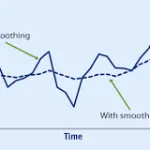
My own research (see Ghosh, Gu and Jain, Review of Accounting Studies 2005), and those of others (see, Barth, Elliott and Finn, Journal of Accounting Research 1999), show that investors reward companies handsomely for reporting sustained increases in earnings over consecutive quarters. When companies are able to meet or beat prior period benchmarks, which include prior period earnings or analyst expectations, investors consider earnings to be of high quality, i.e., earnings are expected to persist into the future. High quality of earnings also indicates lower risk because earnings are perceived as being less volatile. Both arguments suggest a surge in stock price.

 Think of General Electric (GE) under Jack Welsh. As of fiscal year 2000, GE had reported 100 consecutive quarters of increased earnings from continuing operations. During the 90s decade (1990 to 2000), GE stock price had increased from around $5 to $60 (on an adjusted basis), which is a staggering 1,200% growth (or a 25% growth in stock price per annum). 

 Why the Decline in Stock Price

 One explanation could be that the company might have to restate its prior period financial statement from the accounting fraud. However, this is not the case. The company reported that it does not expect to restate its financial results because impact of the accounting manipulation was immaterial to its performance. Further, the company believes that it will not impact the Company’s compliance with the financial covenants in its debt agreements.

A more realistic explanation is that the company will now become the target of several class-action lawsuits for violating federal securities laws by issuing misleading information to investors. For example, Hagens Berman Sobol Shapiro LLP, a national investor-rights law firm, is investigating whether to file a class action lawsuit based on the current information. Similarly, Scott and Scott, Attorneys at Law, LLP, a global investor rights law firm, is also investigating Brixmor for possible securities fraud.

Past studies show that the amount of settlements from class action lawsuits are economically large – a cost which is ultimately borne by investors!  

February 10, 2016; 5.58A

http://www.reuters.com/article/us-brixmor-accounting-idUSKCN0VH13P

mailby feather

Beware of Corporate Nip-Tuck

nip-tuckU.S. public companies must prepare their financial statements according to generally accepted accounting principles (GAAP) and much of the investor attention is concentrated on the Income Statement to asses a company’s operating performance. Any income or earnings to be GAAP compliant must be a separate line item reported on the Income Statement.

Over the last few decades, companies have been increasingly deviating from US GAAP earnings/income by underscoring some form of an adjusted income/earnings, also known as pro-forma earnings (e.g., EBITDA, or adjusted net income). What investors may not realize is that any pro-form number is not GAAP compliant and therefore the adjusted number may convey a biased assessment of the company, which may be the hidden purpose. 

Why?

The adjustments allow companies to exclude expenses such as asset write-downs, impairments, restructuring charges, losses from foreign-currency translations that management believes is not relevant to the company’s most fundamental operations. It should not come as a surprise that most adjusted measures tend to portray a much healthier image of corporate earnings. Companies are willing to go to any lengths or use any definition of earnings to avoid reporting losses.

According to Deutsche Bank research, about one in 10 major companies use the term adjusted EBITDA, up from one in 40 a decade ago. The difference between standard and adjusted earnings is also growing. Deutsche Bank expects the gap to widen to 40% in the fourth quarter of 2015, from 20% or 30% in recent periods. According to Wall Street Journal analysis, about a quarter of earnings disclosed in earnings announcements don’t comply with GAAP.

Example

United Technologies Corp. CEO Greg Hayes reported “…by adhering to accounting rules, we’re actually confusing people more than we were helping people understand what’s going on in the business. This is a simplification and really allows the investors to more easily understand what the businesses are doing.”

The implication is that we don’t need to adhere to accounting standards, we don’t need to worry about complying with the SEC reporting requirements, and we don’t need auditors or their attestation. Let us disregard the mechanisms in place to generate financial information that is representationally faithful, reliable and transparent; instead, let us trust the numbers generated by management according to what they believe is the best definition of earnings. A compelling story.

Regulatory concerns

 According to Mary Jo White, Chair of the Securities and Exchange Commission, “Non-GAAP measures are used extensively and in some instances may be a source of confusion.. This area deserves close attention.”

Regulators occasionally take companies to task for de-emphasizing US GAAP accounting numbers. The SEC has queried companies at least 100 times since 2006 about non-GAAP measures. For example, the SEC told T-Mobile US Inc.  to include figures that comply with accounting rules in its quarterly earnings release. The company had only used adjusted Ebitda, and omitted net income.

Bottom-line

Trust the company’s bottom line number, which is net income, and beware of pro-form or adjusted numbers generated by management!

http://www.wsj.com/articles/u-s-corporations-increasingly-adjust-to-mind-the-gaap-1450142921


mailby feather
Older posts Newer posts

© 2019 Aloke Ghosh

Theme by Anders NorénUp ↑