
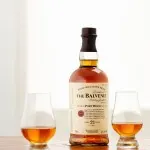
 United States is the largest consumer of Scotch Whiskey. According to Distilled Spirits Council of the United States, Americans consumed 1.7 million cases of Single Malt Scotch and 7.8 million cases of blended Scotch Whiskey in 2013. In 2014, Scotch sales to the US fell by about 10%, according to British government statistics. The Scotch Whisky Association is blaming the decline in sales to a shift in the American drinkers’ palate – US consumers prefer bourbon and other American whiskeys over the Scottish Aqua Vitae.
The per capital consumption of Scotch Whiskey is the highest in Singapore, followed by Latvia, Panama, France and UAE. US per capita consumption Scotch Whiskey ranks fourteenth in the world.
Single Malt Scotch Whisky
Under Scotch Whisky Regulations, Single Malt Scotch Whisky must be made exclusively from malted barley, must be distilled using pot stills at a single distillery, and must be aged for at least three years in oak casks of a capacity not exceeding 700 litres (180 US gallons).
The key criterion for single malt scotch whiskey is that the malted whisky be the product of a single distillery. Regulations do not require production from a single batch or a single barrel. For example, a single-malt Balvenie whiskey may contain whiskies from many barrels produced at the Balvenie distillery, but it contains whiskies exclusively produced at Balvenie. To retain consistency of the product, a master blender at the distillery tastes various barrels that are ready for release and mixes them appropriately.
Blended Scotch Whiskey
Under the Scotch whisky regulations, there can be three styles of blended whiskey.
• Blended malt scotch whisky: A blend of single malts from two or more distilleries. For example, Compass Box purchases whiskies and blends them to create new products with certain characteristics. Peat Monster from Compass Box emphasizes rich, smoky flavor of peat.
• Blended grain scotch whisky: A blend of single grains from two or more distilleries. Single grains are usually known for being light and mild. Compass Box’s Hedonism is a fine example of a blended grain scotch.
• Blended scotch whisky: A blend of both malt whiskies and grain whiskies, sourced from several different distilleries. Brands include Johnnie Walker, Dewar’s, and Chivas Regal.
The chart below divides Scotland into the leading whisky producing regions.
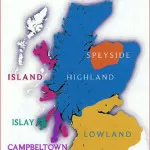
Lowlands
The whiskies produced here are regarded as lighter in body and colour and less assertive than their highland neighbors. Lowland whiskies emphasize the malt more than peat, as in the highlands or brine, as in the islands.
Highlands
By far the biggest region is the Highlands. Bigger, brawnier, and more rounded than Lowland malts, the whiskies from the Highlands carry a wide range of flavors and styles.
Islay
From the island of Islay come rich, iodine-flavored, very smoky, very peaty whiskies. The six distilleries currently in operation on this beautiful island of Islay produce some of the most aromatic of whiskies.
Which region is your favorite? How do you take your Scotch Whiskey, on-the-rocks or straight-up?

 by
by 
Leave a Reply